
It Gets Dark Before You Leave Work. Who Is at Fault When a Driver Hits a Pedestrian?
You leave work at 5:30 p.m.
A few weeks ago, you would have driven home while the sun was still out. Now, the streets are dark, headlights are everywhere, and pedestrians are harder to see.
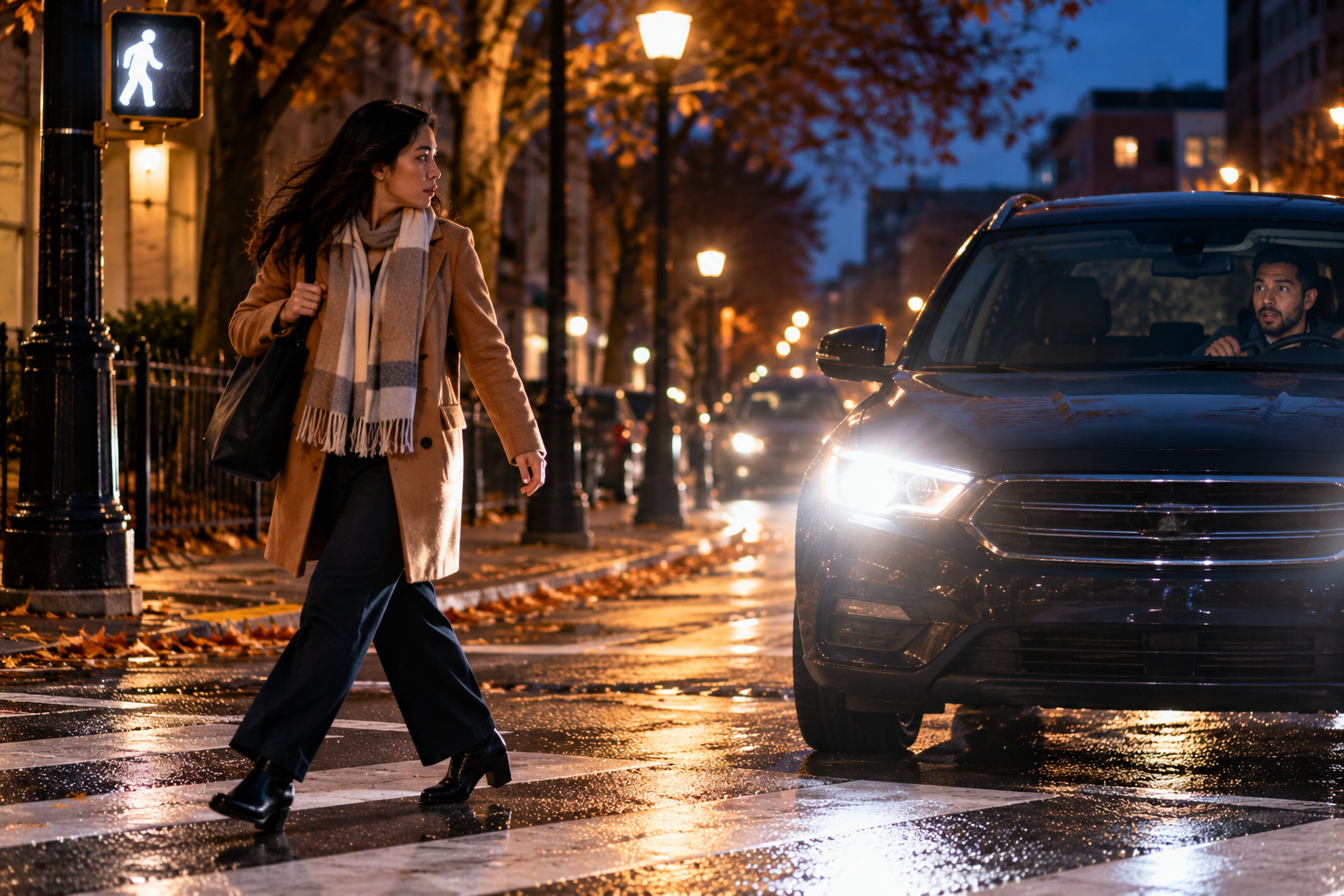
As you approach an intersection, someone steps into the crosswalk.
You hit the brakes, but it is too late.
An accident happens in seconds, and suddenly both the driver and pedestrian are facing a much bigger question.
Who is legally responsible?
When daylight saving time ends, evening commutes become darker almost overnight. For New York drivers and pedestrians, reduced visibility can increase the importance of understanding traffic laws and accident liability.
Drivers Still Have a Responsibility to Watch for Pedestrians
Darkness does not eliminate a driver’s responsibility to operate their vehicle safely.
New York drivers must exercise due care to avoid colliding with pedestrians, even when visibility is reduced.
That means paying attention to crosswalks, intersections, sidewalks, and areas where people may enter the roadway.
Drivers should also adjust their speed and level of caution to match the conditions.
A driver who is traveling at the posted speed limit may still be driving too fast for the circumstances if poor visibility makes it difficult to react safely.
AnnMarie Banushi
Start to finish the process for tickets was easy on stressful and handled with care ! Mark Montanaro was a true gentleman who handled everything follow up calls emails keeping me apprised and taking a situation and turning it around!!!
Does a Pedestrian Always Have the Right of Way?
Not necessarily.
New York law establishes rules governing when drivers must yield to pedestrians and when pedestrians must yield to vehicles.
For example, drivers generally must yield to pedestrians crossing within an applicable crosswalk when traffic control signals are absent or not operating.
However, pedestrians crossing outside a marked or unmarked crosswalk generally must yield to vehicles on the roadway, subject to other applicable rules.
Pedestrians also cannot suddenly leave a curb and enter the path of a vehicle that is so close that the driver cannot reasonably yield.
These distinctions can become important when determining who was responsible for an accident.
What If the Pedestrian Was Wearing Dark Clothing?
Imagine driving down a poorly lit road when someone wearing a dark jacket begins crossing.
You do not notice the person until they are directly in front of your vehicle.
Does that automatically mean the pedestrian is at fault?
No.
Visibility can be relevant to an accident investigation, but it does not automatically determine liability.
Investigators may consider street lighting, weather, vehicle speed, headlights, the pedestrian’s location, and whether either person had a reasonable opportunity to avoid the collision.
A pedestrian’s clothing may be part of the circumstances, but drivers still have a legal duty to exercise reasonable care.
What If the Pedestrian Crossed Outside the Crosswalk?
This is another situation where responsibility may be disputed.
A pedestrian who crosses outside a crosswalk may be required to yield to approaching vehicles.
However, that does not necessarily mean the driver has no responsibility if a collision occurs.
For example, a driver who was speeding, distracted, or failed to respond to a visible hazard may still bear some fault.
New York follows a comparative negligence system, which allows fault to be allocated between parties.
That means both the driver and pedestrian may be found partially responsible, depending on the evidence.
Could the Driver Receive a Traffic Ticket?
Yes, depending on what happened.
If an officer determines that a driver violated an applicable traffic law, the driver may receive a summons.
Possible violations could involve failure to yield, speeding, or another moving violation supported by the circumstances.
A traffic ticket can have consequences beyond the immediate fine, including points on a driving record and potential insurance implications.
However, the fact that an accident occurred does not automatically mean the driver committed a traffic violation.
The evidence and specific charge matter.
What Should You Do After a Pedestrian Accident?
If a pedestrian is struck by a vehicle, obtaining medical assistance should be the first priority.
Call emergency services when needed and remain at the scene as required by law.
Drivers should provide the required information and cooperate with lawful reporting requirements.
If possible, preserve photographs, witness information, dashcam footage, and details about lighting, weather, and road conditions.
These details can become especially important when the accident occurred after dark and the parties disagree about what was visible.
An attorney can review the circumstances and help explain the potential legal consequences.
Darkness Changes the Drive, Not the Responsibility
When the clocks change, drivers may find themselves navigating familiar roads under very different conditions.
Pedestrians can be harder to see, reaction time becomes more important, and an ordinary evening commute can quickly turn into a serious accident.
Drivers should slow down when conditions require it, remain alert near intersections, and watch carefully for people crossing the roadway.
At MontanaroLaw, we help New York drivers address traffic violations and legal issues involving motor vehicle accidents. If you received a traffic ticket following a pedestrian accident or have questions about your legal rights, contact us today to discuss your case and learn how we may be able to help protect your driving record and legal interests.